

 https://doi.org/10.4081/nt.2025.917
Teratologies, malformations and other abnormalities in cuckoo wasps (Hymenoptera, Chrysididae)
All claims expressed in this article are solely those of the authors and do not necessarily represent those of their affiliated organizations, or those of the publisher, the editors and the reviewers. Any product that may be evaluated in this article or claim that may be made by its manufacturer is not guaranteed or endorsed by the publisher.
Accepted: 16 October 2025
Published: 12 November 2025
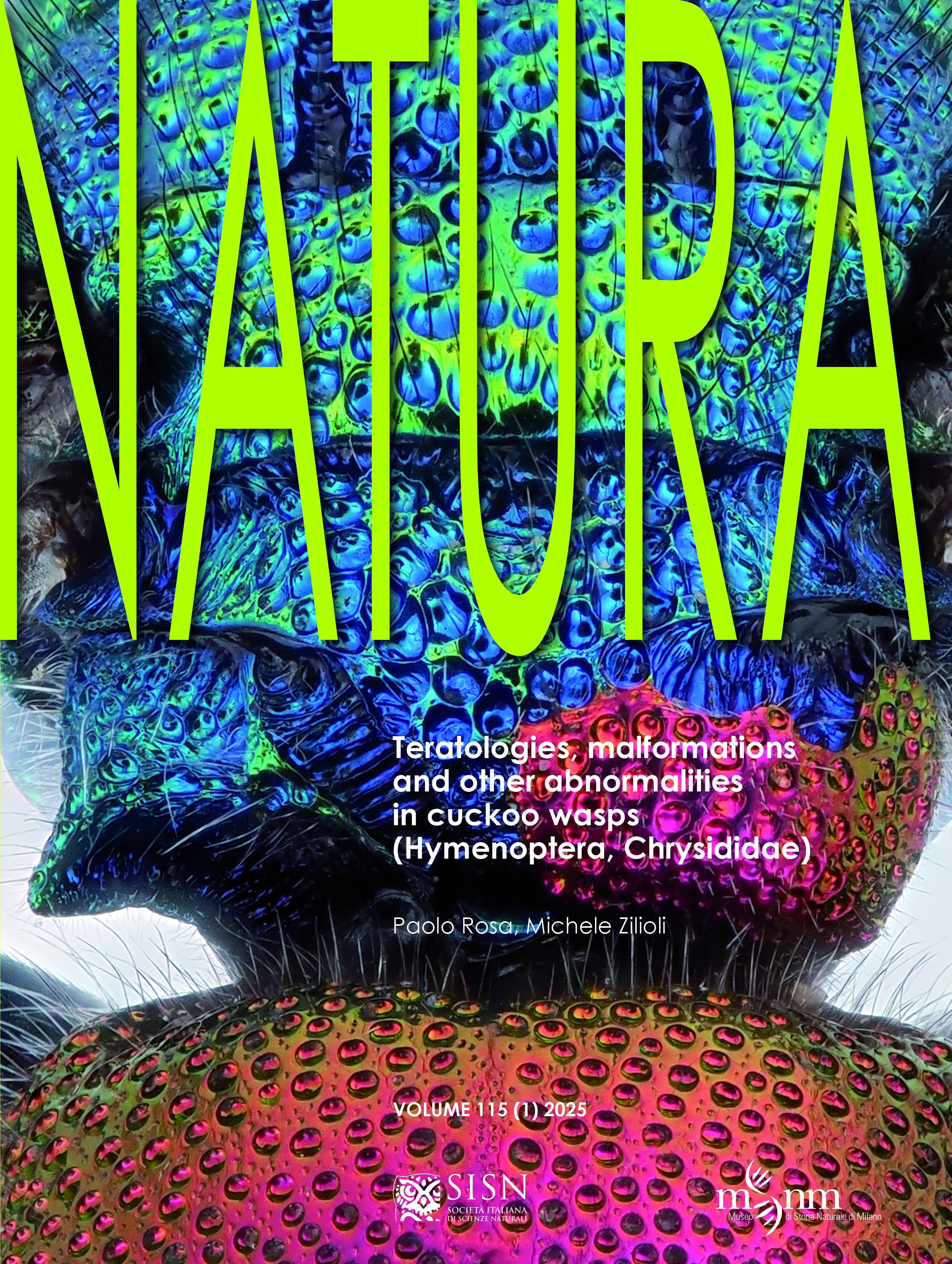
The present publication is the first illustrated catalogue of morphological aberrations observed in a family of non-social hymenopterans. Cephalic, thoracic, abdominal, and appendicular aberrations are recorded. Traditionally, only single cases of aberrations are documented in the literature but we here illustrate 163 cases of malformed Chrysididae observed on a total of 809 specimens recorded, including cases of anarthrogenesis, aplasia, asymmetry, atavism, ectromely, epigastrochisis, helicomery, hemiaplasy, heteromorphosis, heterotopy, hypertrophy, microcephaly, nanism, polymelia, polymery, polyocularism, schistomely, somatomely, symphysocery, symphysomery, tumor-like conditions and cuticular perforations, gynandromorphy and other uncategorized aberrations. Coloration abnormalities, like asymmetric coloration, depigmentation, melanism, rufinism and other variations are also reported. Moreover, new teratological cases are reported for Hymenoptera for the first time, such as a specimen with five legs and five wings, the potential development of embryonic, heteromorphic antenna on legs, and the occurrence of metasomal tissue on mesosoma. Based on material recently collected in Italy, malformations in general were observed in 3.72% of the cases (n= 609) on a total of 16,339 examined and 0.13% for the most spectacular cases, which is in any case a considerably higher percentage than those previously recorded in Hymenoptera and Coleoptera studies based on samples exceeding 10,000 individuals.
Downloads
Agnoli G. & Rosa P., 2024 – Chrysis forum. <https://forum.chrysis.net/>
Balazuc J., 1948 – La tératologie des coléopteres et experiences de transplantation sur Tenebrio molitor L. Memoires des Museum National de Histoire, 25: 1-293.
Balazuc J., 1952 – La tératologie des Hémiptères et groupes voisins. Annales de la Société entomologique de France, 120: 17-67.
Balazuc J., 1958 – La tératologie des Hymenoptéroides. Annales de la Société entomologique de France, 127: 167-203.
Balazuc J., 1969 – Supplément a la tératologie des coléopteres. Redia, 51: 39-111.
Bateson W., 1894 – Materials for the study of variation treated with especial regard to discontinuity in the origin of species. C.J. Clay, London, 476 pp.
Berndt K.P. & Wisniewski J., 1984 – Zur Teratologie der Korperanhange bei der Pharaoameise Monomorium pharaonis (L.) (Hymenoptera, Formicidae). Zoologischer Anzeiger, 213: 313-321.
Bocca F.M., Picciau L., Rosa P., Wood T.J., Caprio E., Niehuis O. & Alma A., 2023 – The leafhoppers Scaphoideus titanus and Orientus ishidae, two invasive vectors of Flavescence Dorée, serve as intermediate hosts of the brood parasitic cuckoo wasp Elampus bidens. Entomologia Generalis, 43: 849-859.
Borderá S. & Tormos J., 1986 – Un bracónido y tres ichneumónidos teratólogicos (Hym., Ichneumonoidea). Boletín de la Asociación española de Entomología, 10: 335-338.
Borsato W., 1995 – Segnalazione di una teratologia su Sulcopolistes sulcifer Zimmermann (Hymenoptera Vespidae). Bollettino del Museo Civico di Storia Naturale di Verona, 19: 453-455.
Bowen W.R. & Stern V.M., 1966 – Effect of temperature on the production of males and sexual mosaics in a uniparental race of Trichogramma semifumatum (Hymenoptera: Trichogrammatidae). Annals of the Entomological Society of America, 59: 823-834.
Brau T. & Michez D., 2025 – First Report of Gynandromorphism in Xylocopa aeneipennis (De Geer) (Hymenoptera: Apidae). Specimen, 42.
Brown W.L. & Nutting W.L., 1949 – Wing venation and the phylogeny of the Formicidae (Hymenoptera). Transactions of the American Entomological Society, 75: 113-132.
Buschinger A. & Stoewesand H., 1971 – Teratologische Untersuchungen an Amaisen. Beiträge zur Entomologie, 21: 211-241.
Cabello-García T. & Vargas-Piqueras P., 1985 – Temperature as a factor influencing the form of reproduction of Trichogramma cordubensis Vargas and Cabello (Hym., Trichogrammatidae). Zeitschrift für Angewandte Entomologie, 100: 434-441.
Camerano L., 1878 – Descrizione di alcuni insetti mostruosi. Atti della Reale Accademia delle Scienze di Torino, 14: 148-154.
Campos A.E.C., Kato L.M. & Zarzuela M.F.M., 2011 – Occurrence of different gynandromorphs and ergatandromorphs in laboratory colonies of the urban ant, Monomorium floricola. Journal of Insect Science, 11: 17.
Chaud-Netto J. & da Cruz-Landim C., 2000 – Changes in the structure and pigmentation of the eyes of honeybee (Apis mellifera L.) queens with the “limão” mutation. Genetics and Molecular Biology, 23: 93-96.
Cockayne E.A., 1929 – Spiral and other anomalous forms of segmentation. Transactions of the Royal Entomological Society of London, 77: 177-184.
Cockayne E.A., 1934 – Spiral and other anomalous forms of segmentation with an account of these ventral spirals in a brood of Hadena dissimilis Kn. Transactions of the Royal Entomological Society of London, 82: 165-172.
Cockayne E.A., 1937 – Insect teratology, reduplication of legs in Coleoptera, Diptera, and Hymenoptera. Transactions of the Royal Entomological Society of London, 86: 191-200.
Comério E.F., Perioto N.W. & Lara R.I.R., 2015 – A Gynandromorph and Teratological Case in Spilomicrus sp. (Hymenoptera, Diaprioidea, Diapriidae). EntomoBrasilis, 8: 249-252.
Constantineanu M.J., 1930 – Quelques anomalies chez les Ichneumonides. Bulletin Muséum National d’Histoire Naturelle, 2: 557-563.
Cummins M., Pueyo J.I., Greig S.A. & Couso J.P., 2003 – Comparative analysis of leg and antenna development in wild-type and homeotic Drosophila melanogaster. Development Genes and Evolution, 213: 319-327.
Damjanov I., 2009 – Pathology Secrets. Third edition. Mosby Elsevier, Maryland Heights, 525 pp.
Danforth B., 1989 – The evolution of hymenopteran wings: the importance of size. Journal of Zoology, 218: 247-276.
Donisthorpe H., 1922 – On some abnormalities in Ants. Entomologist’s Record and Journal of Variation, 34: 81-85.
Earls K.N, Campbell J.B, Rinehart J.P. & Greenlee K.J., 2023 – Effects of temperature on metabolic rate during metamorphosis in the alfalfa leafcutting bee. Biology Open, 12: bio060213.
Engel M.S., Hinojosa-Díaz I.A., Sagot P., Mérida J. & Ayala R., 2014 – A pentocellar female of Caenaugochlora inermis from southern Mexico (Hymenoptera: Halictidae). Journal of the Kansas Entomological Society, 87: 392-394.
Espadaler X. & Riasol J.M., 1983 – Cisticercoides de Cyclophyllidea en hormigas Leptothorax Mayr. Modificaciones morfológicas del huésped intermediario. Revista Ibérica de Parasitología, 43: 219-227.
Forel A., 1920 – Les Fourmis de la Suisse. Seconde éd. revue et corrigée, Ed. Le Flambeau. La Chaux de Fonds, 333 pp.
Forzan M., Sagona S., Mazzei M. & Felicioli A., 2017 – Detection of deformed wing virus in Vespa crabro. Bulletin of insectology, 70: 261-265.
Goss H., 1895 – Emphytus cinctus. Proceedings of the Entomological Society of London, 1895: 8.
Gülmez Y., 2019 – Teratology in the solitary wasp family Sphecidae (Insecta: Hymenoptera). Biologia, 74: 1349-1357.
Halcrow K., 1988 – Absence of epicuticle from the repair cuticle produced by four malacostracan crustaceans. Journal of Crustacean Biology, 8: 346-354
Harbeck M., 1910 – Tenthredinidae. Entomological News, 21: 50.
Harling G., 1902 – Auffälliges Naturspiel. Systematische Hymenopterologie und Dipterologie, 3: 208.
Harris M., 1776 – An exposition of English insects. Vol. 2. White and Robinson, London, 69-70.
Haydak M.H., 1948 – Notes on biology of Cyclopic Bees. Journal of Economic Entomology, 41: 663-664.
Hinojosa-Díaz I.A., Gonzalez V.H., Ayala R., Mérida J., Sagot P. & Engel M.S., 2012 – New orchid and leaf-cutter bee gynandromorphs, with an updated review (Hymenoptera, Apoidea). Zoosystematics and Evolution, 88: 205-214.
Hopwood J., 2007 – A “cyclops” of the bee Lasioglossum (Dialictus) bruneri (Hymenoptera: Halictidae). Journal of the Kansas Entomological Society, 80: 259-261.
Janet C., 1903 – Observations sur les Guêpes. Ed. C. Naud, Paris, 85 pp.
Johnson W.F., 1931 – Glypta nigrotrochanterata Strobl. from Ireland (Hymenoptera). Proceedings of the Royal Entomological Society London, 6A: 52.
Kilimnik A.N. 1993 – Chrysididae of the genus Hedychrum Latreille, 1806 (Hymenoptera) of Eastern Europe. Entomologicheskoye Obozreniye, 12: 388-400 [in Russian] [translated by Entomological Review, 73: 12-24].
Kim J.K., 2016 – New record of the genus Omalus Panzer, 1801 (Chrysididae: Chrysidinae: Elampini) in South Korea, with description of a new species. Entomological Research, 46: 107-112.
Kimsey L.S., 2018 – Morphology and review of the odd genus Rhadinoscelidia Kimsey, 1988 (Hymenoptera, Chrysididae, Loboscelidiinae). Journal of Hymenoptera Research, 62: 45-54.
Kimsey L.S. & Bohart R.M., 1991 – The Chrysidid Wasps of the World. Oxford University Press, New York, 652 pp.
Kloiber J., 1936 – Abnormales Flügelgeder von Tenthrediniden (Hym.). Konowia, 15: 152-154.
Konow Fr.W., 1900 – Abnorme Kopfbildung bei Tenthredopsis elegans Knw. (Hym.). Zeitschrift für Entomologie, 5: 117-118.
Kraatz G., 1876 – Ueber eine merkwürdige Monstrosität bei Cimbex axillaris (Hymenopt.). Deutsche Entomologische Zeitschrift, 20: 377.
Kroiss J., Strohm E., Vandenbem C. & Vigneron J-P., 2009 – An epicuticular multilayer reflector generates the iridescent coloration in chrysidid wasps (Hymenoptera, Chrysididae). Naturwissenschaften, 96: 983-986.
Kriechbaumer J., 1889 – Höchst merkwürdige Missbildung eines Fühlers von Bombus variabilis Schmkn. Entomologische Nachrichten, 15: 281.
Kutter H., 1952 – Bemerkenswerte Missbildung bei Leptothorax acervorum Latr. (Hym. Formicid.). Mitteilungen der Schweizerischen Entomologischen Gesellschaft, 25: 354.
Laciny A., 2021 – Among the shapeshifters: parasite induced morphologies in ants (Hymenoptera, Formicidae) and their relevance within the EcoEvoDevo framework. EvoDevo, 12: 2.
Lanes G.O., Kawada R., Azevedo C.O. & Brothers J.D., 2020 – Revisited morphology applied for Systematics of flat wasps (Hymenoptera, Bethylidae). Zootaxa 4752: 1-127.
Lewis E.B., 1978 – A gene complex controlling segmentation in Drosophila. In: Genes, development, and cancer. Lipshitz H.D. (eds.). Springer, Dordrecht.
Linsenmaier W., 1959 – Revision der Familie Chrysididae (Hymenoptera) mit besonderer Brücksichtigung der europäischen Spezies. Mitteilungen der Schweizerischen Entomologischen Gesellschaft, 32: 1-232.
Linsenmaier W., 1999 – Die Goldwespen Nordafrikas (Hymenoptera, Chrysididae). Entomofauna, supplement 10: 1-210.
Lohrmann V. & Engel M.S., 2015 – A quadriocellar scoliid wasp (Hymenoptera, Scoliidae) from Mallorca, with a brief account of supernumerary ocelli in insects. Zoosystematics and Evolution, 91: 191-197.
Lohrmann V., Waldren G.C., Reiß M. & Engel M.S., 2016 – An anocellar polistine wasp (Hymenoptera, Vespidae, Polistinae) from Texas. Zoosystematics and Evolution, 92: 251-255.
López F. & Ortuño V.M., 1992 – Five teratological cases in Tetramorium Mayr and Leptothorax Mayr, and some comments on the incidence os teratologies in ants. The Entomologist, 111: 123-133.
Maazed A.M.M., 2011 – Anomalies and asymmetry of wing venation pattern in Carniolan and Egyptian bee populations in Egypt. Egyptian Academic Journal of Biological Sciences. A, Entomology, 4: 149-161.
Martin S.J. & Brettell L.E., 2019 – Deformed wing virus in honeybees and other insects. Annual Review of Virology, 6: 49-69.
Martynova K.V. & Fateryga A.V., 2014 – Omalus sculpticollis as the main enemy of Psenulus fuscipennis (Hymenoptera: Chrysididae, Crabronidae) in the Crimea, Ukraine. Vestnik zoologii, 48: 11-26.
Michez D., Rasmont P., Terzo M. & Vereecken N.J., 2009 – A synthesis of gynandromorphy among wild bees (Hymenoptera: Apoidea), with an annotated description of several new cases, Annales de la Société Entomologique de France, 45: 365-375.
Móczár L., 1963 – Einige Missbildungen bei Hymenopteren (Chrysididae). Folia Entomologica Hungarica, 16: 63-66.
Moller G.J., 1975 – A list of Irish sawflies (Hymenoptera: Symphyta) in the Ulster Museum: Including a new Irish record and a note on a teratological specimen of Hemichroa Steph. The Irish Naturalists’ Journal, 18: 133-136.
Møller A.P. & Swaddle J.P., 1997 – Asymmetry, Developmental Stability and Evolution. Oxford University Press, 291 pp.
Morice F.D., 1908 – Teratological specimen of a bee. Transactions of the Entomological Society of London, 1907-1908: lxi-lxii.
Narita S., Pereira R.A.S., Kjellberg F. & Kageyama D., 2010 – Gynandromorphs and intersexes: potential to understand the mechanism of sex determination in arthropods. Terrestrial Arthropod Reviews, 3: 63-96.
Negru St., 1955 – Sur deux cas d’anomalies chez les insectes. Comunicările Academiei Republicii Populare Romîne, 5: 807-809.
Negru St., 1958 – Contribution à l’étude des Chrysididae de la R.P. Roumaine. Comunicările Academiei Republicii Populare Romîne, 8: 589-592.
Niehuis O. & Wägele J.W., 2004 – Phylogenetic analysis of the mitochondrial genes LSU rRNA and COI suggests early adaptive differentiation of anal teeth in chrysidine cuckoo wasps (Hymenoptera: Chrysididae). Molecular Phylogenetics and Evolution, 30: 615-622.
Ornosa Gallego C., 1985 Dos casos de teratología en Bombinae (Hym., Apidae). Boletín de la Asociación española de Entomología, 9: 367-370.
Ornosa C., Cascales E. & Ortiz-Sánchez F.J., 2001 – Nuevos casos teratológicos en Apoidea (Hymenoptera). Anales de Biología, Biología Animal, 12: 19-24.
Paukkunen J., Berg A., Soon V., Ødegaard F. & Rosa P., 2015 – An illustrated key to the cuckoo wasps (Hymenoptera, Chrysididae) of the Nordic and Baltic countries, with description of a new species. ZooKeys, 548: 1-116.
Pauli T., Castillo-Cajas R.F., Rosa P., Kukowka S., Berg A., van den Berghe E., Fornoff F., Hopfenmüller S., Niehuis M., Peters R.S., Staab M., Strumia F., Tischendorf S., Schmitt F., Niehuis O., 2019 – Phylogenetic analysis of cuckoo wasps (Chrysididae) reveals the partially artificial nature of the current classification at the genus level in this family of Hymenoptera. Systematic Entomology, 44: 322-335.
Penteado-Dias A.M., Nunes J.F. & Shimbori E.M., 2005 – Observations on some teratological Braconidae (Hymenoptera, Ichneumonoidea) from Brazil. Entomotropica, 20: 113-114.
Pérez-Lachaud G., Rocha F.H. & Lachaud J.P., 2024 – A Neoponera villosa (Fabricius, 1804) Worker Pupa with too Many Legs (Hymenoptera: Formicidae). Neotropical Entomology, 53: 997-1001.
Peters K. & Gibbs J., 2024 A Quadriocellar Hedychridium caeruleum (Hymenoptera: Chrysididae) from Manitoba, Canada. The Great Lake Entomologist, 57: 81-85.
Pic M., 1922 – Quelques anomalies en Entomologie. Revue Scientifique du Bourbonnais et du Centre de la France, 4: 112-113.
Poisson R., 1942 – Contribution à la Tératologie des Insectes. Sur un individu anormal de Myrmecina graminicola Latreille (Hyménoptère Formicidé, Myrméciné) porteur d’une patte surnuméraire à l’extrémité de l’abdomen. Bulletin biologique de la France et de la Belgique, 76: 239-243.
Porporato M., Laurino D., Balzola L. & Manino A., 2014 – Wing venation teratology in Apis mellifera L. Redia, 97: 157-163.
Portman Z.M. & Griswold T., 2016 – An anomalous specimen of Perdita wasbaueri Timberlake with only one antenna (Hymenoptera: Andrenidae). Journal of the Kansas Entomological Society, 89: 267-269.
Proshchalykin M. Yu., 2003 – Anomaly of the antennae of Nomada comparata Cockerell, 1911 (Hymenoptera, Apidae). Far Eastern Entomologist, 128: 15-16.
Rafael J.A., Almeida Marques, D.W. & Engel M.S., 2017 – The first gynandromorph of a zorapteran and potential thelytokous parthenogenesis in a population of Zorotypus brasiliensis Silvestri (Zoraptera: Zorotypidae). Revista Brasileira de Entomologia, 61: 318-322.
Richardson N.M., 1891 – Zygaena filipendulae. Proceedings of the Field Club, 1891: x.
Ronshaugen M., McGinnis N. & McGinnis W., 2002 – Hox protein mutation and macroevolution of the insect body plan. Nature, 415: 914-917.
Rosa P., 2006 – I Crisidi della Valle d’Aosta. Monografie del Museo regionale di Scienze Naturali, 6, 368 pp.
Rosa P., 2019a – Cleptes pallipes var. androgyna du Buysson, 1896 is a gynandromorph of Cleptes semiauratus (Linnaeus, 1761) (Hymenoptera: Chrysididae). Linzer Biologische Beiträge, 51: 391-396.
Rosa P., 2019b – New species of Chrysididae (Hymenoptera) from Central Asia, Russia and Iran. Part II. Far Eastern Entomologist, 377: 1-25.
Rosa P., 2024a – New teratological cases in cuckoo wasps, with synonymization of Oligogaster Soliman & Kimsey, 2013 (Hymenoptera, Chrysididae). Zootaxa, 5424: 225-233.
Rosa P., 2024b – A journey through the history of the British Chrysididae (Hymenoptera): unexpected taxonomic problems, new records and description of a new species. Journal of Natural History, 58: 840-889.
Rosa P. & Zettel H., 2018 – First record of gynandromorphism in the subfamily Chrysidinae (Hymenoptera, Chrysididae). Linzer Biologische Beiträge, 50: 801-808.
Safavi M., 1968 – Etude biologique et écologique des Hyménoptères parasites des oeufs cles punaises des céréales. Entomophaga, 13: 381-495.
Salt G., 1927 – The effects of stylopization on aculeate Hymenoptera. Journal of Experimental Zoology, 48: 223-331.
Sart A., 1964 – Sobre un Polistes gallicus teratomorfo (Hymenoptera). Graellsia, 20: 213-224.
Sato O., 1940 – Abnormal segmentation of the abdomen of Nomada japonica Smith. Transactions of the Kansai Entomological Society, 10: 6-7.
Savini V. & Furth D., 2004 – Teratology in Coleoptera: a case in Gioia bicolor (Blake 1969) (Chrysomelidae, Alticinae) from Jamaica. Entomotropica, 19: 165-167.
Schneider N. & Feitz F., 2007 – Hélicomérie abdominale observée chez Agenioideus sericeus (Vander Linden, 1827) (Insecta, Hymenoptera, Pompilidae). Bulletin de la Société des naturalistes luxembourgeois, 108: 53-54.
Schneuwly S., Klemenz R. & Gehring W., 1987 – Redesigning the body plan of Drosophila by ectopic expression of the homoeotic gene Antennapedia. Nature, 325: 816-818.
Selander R., 1958 – Melanism in some Meloidae (Coleoptera) from the Pinacate Lava Cap in northwestern Sonora, Mexico. Transactions of the Kansas Academy of Science, 61: 77-80.
Shields J.D. & Small H.J., 2013 – An unusual cuticular tumor-like growth on the abdomen of a lobster, Homarus americanus. Journal of Invertebrate Pathology, 114: 245-249.
Skvarla M.J. & Dowling A.P.G., 2014 – First report of gynandromorphism in Temnothorax curvispinosus (Mayr, 1866) (Hymenoptera: Formicidae). Proceedings of the Entomological Society of Washington, 116: 349-353.
Smulyan M.T., 1923 – New England Sawflies of the genus Tenthredella Rohwer. Proceedings of the Boston Society of Natural History, 36: 383-466.
Strumia F., 2004 – Lectotype designation of Hedychridium virescens Buysson, 1908, male description of Cleptes juengeri Linsenmaier, 1994 and of the female of C. triestensis Móczár, 2000 (Hymenoptera, Chrysididae). Bollettino del Museo regionale di Scienze naturali Torino, 21: 475-486.
Tan K., Fuchs S. & Engel M.S., 2008 – An adventitious distal abscissa in the forewing of honey bees (Hymenoptera: Apidae: Apis). Apidologie, 39: 674-682.
Tiedemann F., 1819 – Beschreibung einiger seltenen Thier-Missgeburten. Archiv für die Physiologie, 5: 125-131.
Torres F. & Ramos M., 2000 – Teratologías en apóideos ibéricos (Hymenoptera, Apoidea). Boletín de la Asociación española de Entomología, 24: 25-31.
True J.R., 2003 – Insect melanism: the molecules matter. Trends in Ecology & Evolution, 18: 640-647.
Tussac H. & Balazuc J., 1991 – Anomalies de l’appareil visuel chez des Hyménoptères Apocrites. L’Entomologiste, 47: 49-52.
Veenendaal R.L., 2011 – Pseudomalus triangulifer, een nieuwe kogelgoudwesp voor de Nederlandse fauna (Hymenoptera: Chrysididae). Nederlandse Faunistische Mededelingen, 35: 17-20.
Veenendaal R.L., 2012 – De biologie van de goudwesp Holopyga generosa (Hymenoptera: Chrysididae). Nederlandse Faunistische Mededelingen, 37: 39-43.
Wagner A.C.W., 1915 – Eine Biene mit “Beinfühlern”. Zeitschrift für Wissenschaftliche Insektenbiologie, 11: 218-219.
Wcislo W.T., Gonzalez V.H. & Arneson L., 2004 – A review of deviant phenotypes in bees in relation to brood parasitism, and a gynandromorph of Megalopta genalis (Hymenoptera: Halictidae). Journal of Natural History, 38: 1443-1457.
Wei N-s., Rosa P., Liu J-x. & Xu Z-f., 2014 – The genus Omalus Panzer, 1801 (Hymenoptera, Chrysididae) from China, with descriptions of four new species. ZooKeys, 407: 29-54.
West-Eberhard M.J., 2003 – Heterotopy. In: Developmental Plasticity and Evolution. Oxford Academic, New York, 255-259.
Wheeler W.M., 1896 – An antenniform extra appendage in Dilophus tibialis, Loew. Archiv für Entwicklungsmechanik der Organismen, 3: 261-268.
Winterhagen P., 2015 – Strategy for sneaking into a host’s home: The cuckoo wasp Omalus biaccinctus (Hymenoptera: Chrysididae) inserts its eggs into living aphids that are the prey of its host. European Journal of Entomology, 112: 557-559.
Whiting A.R., 1934 – Eye colours in the parasitic wasp Habrobracon and their behaviour in multiple recessives and in mosaics. Journal of Genetics, 29: 99-107.
With C.J., 1905 – On Chelonethi, chiefly from the Australian region, in the collection of the British Museum, with observations on the “coxal sac” and on some cases of abnormal segmentation. Annals and Magazine of Natural History, 15: 94-143.
Wolf H., 2004 – Zwitter von Chrysis pseudodichroa Linsenmaier 1959 und Megachile pilidens Alfken 1924 (Hymenoptera, Chrysididae und Apidae). Linzer biologiche Beiträge, 36: 525-526.
Wurdack M., Herbertz S., Dowling D., Kroiss J., Strohm E., Baur H., Niehuis O. & Schmitt T., 2015 – Striking cuticular hydrocarbon dimorphism in the mason wasp Odynerus spinipes and its possible evolutionary cause (Hymenoptera: Chrysididae, Vespidae). Proceedings of the Royal Society B: Biological Sciences, 282: e20151777.
How to Cite

This work is licensed under a Creative Commons Attribution-NonCommercial 4.0 International License.
PAGEPress has chosen to apply the Creative Commons Attribution NonCommercial 4.0 International License (CC BY-NC 4.0) to all manuscripts to be published.